



Who controls aircraft flight paths?
All aircraft routing decisions are made by the Federal Aviation Administration (FAA). Palm Beach County, which owns and operates Palm Beach International Airport (PBI), does not control where aircraft fly once they are airborne.
What is a Standard Instrument Departure (SID)?
A Standard Instrument Departure (SID) is a pre-planned and published departure route that pilots follow immediately after takeoff, especially at busy airports. SIDs provide standardized, predictable routes for aircraft to safely and efficiently depart an airport, providing a general corridor for planes to follow. Its purpose is to safely and efficiently guide aircraft away from the airport while keeping air traffic organized, reducing noise over populated areas, and ensuring safe operations during low visibility or poor weather conditions. SIDs are primarily used by airlines and larger aircraft, though business jets and some general-aviation flights may use them when required. A SID provides pilots with specific instructions such as the departure runway, headings or turns, altitude and speed restrictions, and navigation fixes to follow, functioning much like a highway on-ramp that smoothly transitions aircraft from takeoff into the enroute phase of flight.
Why don’t all planes follow the exact same path?
A SID is like a corridor in the sky — not a single line. Planes may fly slightly different paths within that corridor due to differences in aircraft type, climb performance, weather and real-time instructions from air traffic control. Pilots may request deviations from published routes for a variety of reasons. Additionally, they may track slightly differently based on allowable tolerances with onboard equipment (i.e. GPS).
Why are some planes flying outside the SID corridor?
Not all aircraft are equipped to fly the SID. In those cases, air traffic controllers assign alternate headings to ensure safety. Even SID-capable aircraft may be directed off the path temporarily to maintain safe separation or manage traffic flow.
What’s the difference between SID and vectoring?
A SID is a planned route that aircraft follow after takeoff, like a mapped corridor in the sky. Vectoring, on the other hand, is when air traffic controllers give pilots real-time instructions such as turns or altitude changes—to manage traffic or ensure safety. Even with a SID in place, vectoring may still be used when needed.
Why were flight paths more inconsistent before the new standardized procedures?
Before the standardized procedures were implemented, all aircraft were provided a vector heading for departure. Based on the aircraft performance and weather conditions, each aircraft turned at a different point to the pre-defined heading, which led to less consistent flight paths. The new standardized procedures bring more structure and consistency to departures by guiding aircraft along a pre-defined corridor. Exhibit 1 below provides a graphic depicting the departure flight tracks on Runway 10L at PBI prior to the implementation of the SID procedures (January 21, 2026) and after the implementation of the SID procedures (January 24, 2026). Exhibit 2 provides a historical review of flight track activity showing Runway 10L departures at different times during calendar year 2024, prior to the President taking office.
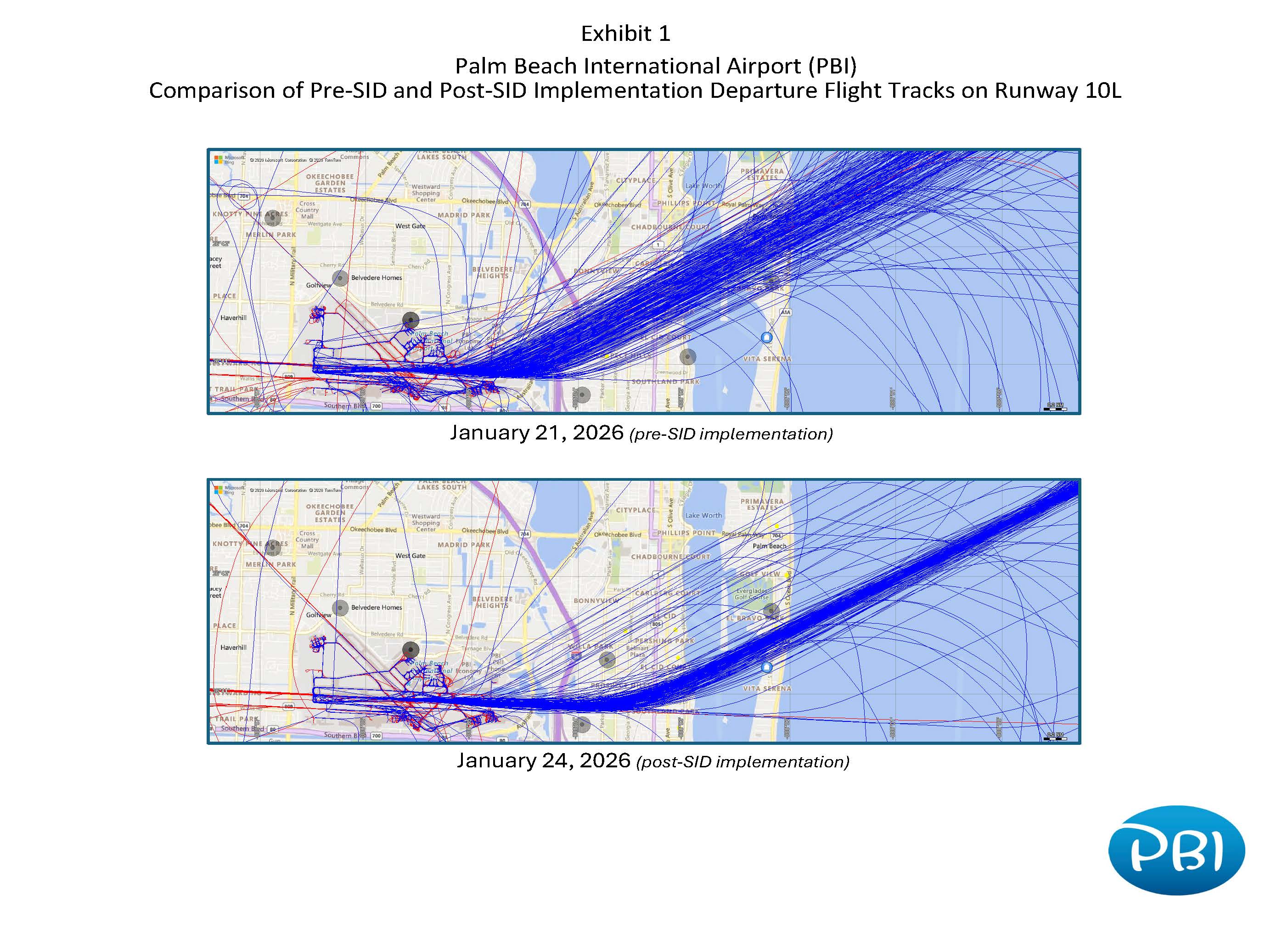

Were the new procedures implemented because Palm Beach County filed a Petition for Review challenging the new Temporary Flight Restriction (TFR) that is in place when the President is not in residence?
No, the FAA published the new procedures in order to formalize and standardize procedures to be followed by aircraft to avoid the Temporary Flight Restriction (TFR) over Mar-A-Lago.
What is the airport doing about community concerns?
Palm Beach International Airport is actively monitoring how the new procedures are being implemented and is continuing to work with the FAA to advocate for solutions that reflect both operational needs and community concerns. The new Standard Instrument Departure (SID) was specifically designed to route aircraft away from the Temporary Flight Restriction (TFR) area that is in effect. However, even with the SID in place, all routing decisions remain under the sole authority of the FAA, who may issue real-time adjustments for safety, traffic flow, or aircraft limitations.
Is it true that the new standardized flight procedures were implemented by the FAA in response to the number of noise complaints received by the County’s Department of Airports?
No, the new procedures have been in development by the FAA since the new TFR went into effect on Oct. 20, 2025; the new procedures, which were developed to formalize and standardize the procedures to be followed by aircraft to avoid the TFR over Mar-A-Lago, became effective on Jan. 22, 2026.
Why are aircraft capable of flying the revised SID still flying north of the new corridor?
Most aircraft that depart out of PBI are operating on one of multiple SIDs. The revised SID follows a defined track just north of Mar-A-Lago, which is the primary SID utilized by aircraft departing PBI; however, not all SIDs fall within this same corridor.
What is meant by the term “aircraft climb gradient?”
An "aircraft climb gradient" simply describes how quickly an airplane gains altitude after takeoff. It measures how much height the aircraft gains over a certain distance traveled forward. Climb gradient is usually described in "feet per nautical mile." For example, a climb gradient of 300 feet per nautical mile (300'/NM) means the aircraft climbs 300 feet in altitude for every mile it travels forward.
The rate at which aircraft must climb after takeoff is carefully planned and published in official departure procedures. The standard minimum climb rate for most departures is 200'/NM. This ensures aircraft safely clear buildings, towers, and other obstacles. Before the TFR was put in place, aircraft were using this standard climb rate. As of January 2026, the FAA required aircraft to climb more steeply, 500'/NM until reaching 520 feet in altitude. In simple terms, aircraft are required to climb faster and gain altitude more quickly after takeoff during the initial segments of flight than they would under normal procedures.